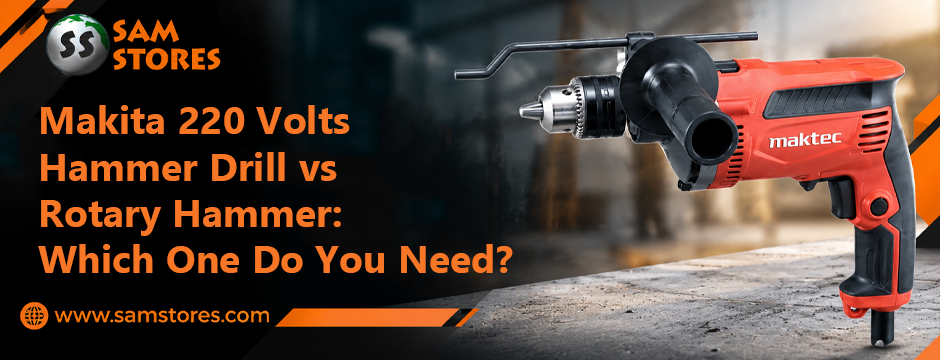
Makita 220 Volts Hammer Drill vs Rotary Hammer: Which One Do You Need?

Buying a power tool for concrete or masonry work sounds straightforward until you start comparing hammer drills with rotary hammers.

Both can drill into hard materials. Both use impact action. Both are available in corded configurations. Yet they are not designed for exactly the same jobs.

For a homeowner putting up shelves, a contractor installing anchors, or a tradesperson drilling through masonry regularly, choosing the wrong tool can mean slower work, unnecessary fatigue and a tool that does not match the job.

A Makita 220 Volts Hammer Drill can be an excellent choice when you need a versatile drill capable of handling wood, metal, masonry and routine fastening work. A rotary hammer is generally the better option when the work involves frequent drilling into hard concrete, larger holes or heavier demolition.

So which one belongs in your toolbox?

The answer depends on what you actually plan to do with it.

Hammer Drill vs Rotary Hammer: The Basic Difference

The easiest way to understand the difference is to look at how the two tools create impact.

A hammer drill uses a rapid hammering action while the bit rotates. The impact mechanism helps the bit work through brick, block and lighter masonry.

A rotary hammer uses a more substantial hammering mechanism. It is designed for demanding masonry and concrete applications and can deliver considerably more impact force.

That distinction matters.

If you occasionally need to drill small holes for wall plugs or masonry anchors, a hammer drill can provide the flexibility you need. If your daily work involves drilling deep holes into reinforced or hard concrete, a rotary hammer is usually the more appropriate tool.

Where a Makita 220 Volts Hammer Drill Makes Sense

A hammer drill earns its place in a toolbox because it is not limited to masonry.

Switch off the hammer function and it can often be used for conventional drilling applications, depending on the model. That makes it useful for tradespeople and serious DIY users who work with different materials.

Typical applications include:

  • Drilling into brick
  • Drilling into block
  • Installing masonry anchors
  • Drilling wood
  • Drilling metal
  • General construction work
  • Home renovation
  • Workshop projects
  • Light to moderate masonry jobs

For someone who wants one corded tool capable of tackling a range of everyday drilling tasks, a Makita hammer drill can be a practical investment.

The 220V configuration is particularly relevant for buyers shopping for tools intended for compatible electrical systems outside standard 110V markets.

Before purchasing, always verify the tool’s voltage and frequency requirements against your local electrical supply.

When a Rotary Hammer Is the Better Choice

Now imagine a different type of job.

You need to drill dozens of holes into a concrete slab. The holes are relatively large, the material is hard, and the work continues for several hours.

That is where a rotary hammer starts to make much more sense.

Rotary hammers are designed around higher-impact applications. Depending on the model and bit system, they can handle jobs such as:

  • Heavy concrete drilling
  • Large masonry holes
  • Anchoring work
  • Chiselling
  • Tile removal
  • Concrete demolition
  • Construction and renovation work

Some rotary hammers offer different operating modes, allowing the user to drill with rotation and impact, drill without impact, or use hammer-only action for chiselling.

That additional capability is one reason professional contractors often keep both types of tools available.

Which Tool Is More Powerful?

In most cases, a rotary hammer delivers substantially greater impact force than a standard hammer drill.

However, “more powerful” does not automatically mean “better.”

If you are drilling a few small holes in brick, the extra size and weight of a rotary hammer may not provide much practical benefit.

You may actually prefer a hammer drill because it is easier to handle and more versatile for everyday jobs.

On the other hand, if you regularly work with concrete, the stronger impact mechanism of a rotary hammer can save time and reduce the amount of effort required.

Think about it this way:

Hammer drill: versatility first.

Rotary hammer: heavy-duty masonry performance first.

What About Speed and Control?

Speed is another area where buyers sometimes focus on the wrong specification.

A high RPM figure can look impressive on a product page, but drilling performance depends on more than rotational speed.

Material, bit type, impact force, torque and operator technique all affect the result.

For general drilling, variable speed can be useful because it allows you to adapt the tool to different materials and applications.

For masonry, impact performance becomes increasingly important as the material gets harder.

That is why comparing tools solely by RPM can lead to a poor purchasing decision.

Look at the complete specification rather than one headline number.

The Importance of the Right Drill Bit

Even an excellent power tool will struggle with the wrong accessory.

Masonry and concrete require appropriate bits designed for the material and the tool’s chuck or bit system.

Using an unsuitable bit can result in slow drilling, excessive heat, poor hole quality and unnecessary wear.

Before buying a hammer drill or rotary hammer, check which bit system it accepts and whether the accessories you need are readily available.

This becomes particularly important for professionals who cannot afford frequent interruptions to replace or locate specialised accessories.

Hammer Drill or Rotary Hammer for Home Renovation?

For many homeowners, the answer depends on the renovation project.

Installing curtain brackets, shelves, cabinets or wall-mounted equipment into brick or block does not necessarily justify buying a heavy rotary hammer.

A hammer drill may be more convenient because it can handle several other drilling tasks around the home.

However, renovations involving concrete floors, extensive masonry work or tile removal can quickly move into rotary-hammer territory.

If you are renovating an older property and expect to encounter substantial masonry work, having access to a rotary hammer can make difficult jobs considerably easier.

What About Professional Contractors?

Professionals should consider workload rather than occasional capability.

A contractor who drills a handful of masonry holes each week may get excellent value from a versatile hammer drill.

A concrete installer, electrician, plumber or construction worker drilling anchors throughout the day may benefit much more from a rotary hammer designed for continuous heavy-duty work.

Ergonomics matter here, too.

If a tool is going to be used for hours rather than minutes, weight, grip, vibration control and overall handling can affect productivity and comfort.

The best tool is the one that matches the work you repeatedly perform.

How Does Voltage Fit Into the Decision?

The 220V specification deserves attention when shopping for international power tools.

A 220V tool is designed to operate with a compatible electrical supply. It should not be treated as a universal replacement for a 110V tool simply because the voltage is higher.

Buyers should check:

  • Rated voltage
  • Frequency
  • Plug configuration
  • Amperage
  • Electrical circuit requirements
  • Compatibility with the intended location

This is especially important when purchasing imported Makita 220 Volts Power Tools.

Do not assume that a plug adapter changes the operating voltage. An adapter changes the physical connection, not the electrical characteristics supplied to the tool.

If you are uncertain about compatibility, check the manufacturer’s specifications or speak with a qualified electrician.

Is a Hammer Drill Enough for Concrete?

This is one of the most common questions buyers ask.

The answer is: sometimes.

A hammer drill can handle many smaller concrete and masonry drilling tasks when paired with the correct bit. But there is a point where the job becomes better suited to a rotary hammer.

Hole diameter, drilling depth, concrete hardness and the number of holes you need to make all matter.

If you only need to drill a few small holes, a hammer drill may be perfectly adequate.

If you are drilling large, deep holes repeatedly, a rotary hammer is likely to be the smarter investment.

Trying to force a general-purpose tool through work that requires a specialised machine rarely saves money in the long run.

Can You Use a Rotary Hammer for Everyday Drilling?

Technically, a rotary hammer can handle many drilling applications, particularly when it has the appropriate modes and accessories.

But that does not mean you should automatically choose one for every job.

Rotary hammers tend to be larger and heavier than conventional hammer drills. Carrying a heavy tool around for simple drilling tasks can become inconvenient.

For a toolbox that needs to cover a broad range of everyday work, a hammer drill can be the more balanced option.

For a dedicated concrete or masonry toolkit, a rotary hammer becomes much more attractive.

Don’t Forget the Rest of Your Toolkit

A good workshop is rarely built around one tool.

Once you start taking on construction, renovation or maintenance projects, different tools serve different purposes.

For example, a hammer drill may cover drilling applications while an angle grinder handles cutting, grinding and surface preparation. A circular saw can take care of many wood-cutting jobs.

If you are building a compatible collection of corded tools, you can explore options such as a Makita 220 Volts Angle Grinder alongside other Makita 220 Volts Power Tools.

A well-matched toolkit can be more useful than spending the entire budget on one exceptionally powerful machine.

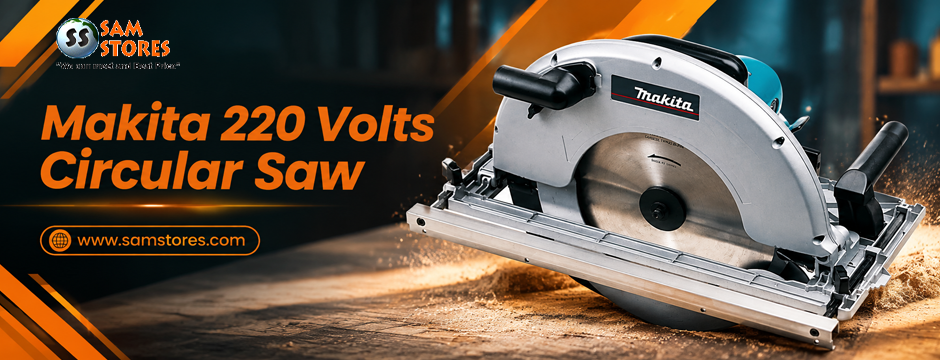
For cutting applications, you may also want to consider a Makita 220 Volts Circular Saw when the project calls for a dedicated saw rather than trying to make a drill do a job it was never designed to perform.
How The Braun 220 Volt Hair Dryer Redefines Everyday Glamour_

Makita Hammer Drill vs Rotary Hammer: Quick Comparison

FeatureHammer DrillRotary Hammer
Small masonry holesExcellentMore than capable
Wood drillingExcellentModel dependent
Metal drillingExcellentModel dependent
Hard concreteModerate to goodExcellent
Large holesLimitedExcellent
ChisellingGenerally unavailableAvailable on suitable models
PortabilityUsually easierGenerally heavier
VersatilityHighMore specialised
Heavy masonry workLimitedExcellent
Occasional DIY useVery suitableMay be excessive

Which One Should You Buy?

If your projects change from one material to another and you want a versatile corded drilling tool, a Makita 220 Volts Hammer Drill is worth considering.

It can be a sensible choice for homeowners, maintenance workers, installers and contractors who need one tool for a mixture of drilling tasks.

If your work is dominated by hard concrete, deep holes, larger masonry applications or chiselling, step up to a rotary hammer.

There is no prize for buying the biggest tool in the shop. The better purchase is the one that fits your actual workload.

At Sam Stores, the goal should be to choose based on application, electrical compatibility, tool specifications and long-term usefulness. A carefully selected power tool can serve you for years, while an unsuitable one can become an expensive item sitting on a shelf.

Final Verdict

So, Makita 220 Volts Hammer Drill or rotary hammer?

Choose the hammer drill when you value versatility and regularly work across wood, metal and lighter masonry.

Choose the rotary hammer when concrete and heavy masonry are the main part of your workload.

And if you are still undecided, look at the jobs you perform most often. The answer usually becomes obvious once you stop thinking about the tool itself and start thinking about the work it needs to accomplish.

The right drill is not necessarily the most powerful one. It is the one that gives you the right combination of power, control, versatility and practicality for the projects ahead.

FAQs

1. Is a Makita 220 Volts Hammer Drill good for concrete? 

Yes. A hammer drill can handle many smaller concrete drilling jobs with the correct masonry bit. For frequent heavy-duty concrete drilling, a rotary hammer is generally more suitable.

2. What is the main difference between a hammer drill and a rotary hammer? 

A rotary hammer typically produces a stronger impact force and is designed for heavier concrete and masonry applications. A hammer drill is generally lighter and more versatile for everyday drilling.

3. Should I buy a hammer drill or rotary hammer for home renovation? 

For occasional drilling into brick or block, a hammer drill is often sufficient. If the renovation involves extensive concrete drilling or chiselling, a rotary hammer may be the better choice.

4. Are Makita 220V power tools compatible with every 220V outlet? 

Not necessarily. You should verify the tool’s voltage, frequency, amperage and plug configuration before connecting it to an electrical supply.

5. Is a rotary hammer better than a hammer drill? 

Neither is universally better. A rotary hammer is better for demanding concrete and masonry work, while a hammer drill offers greater versatility for users working across different materials.

Noise, Heat & Reliability: What Transformers Don’t Tell You

When most people shop for transformers, they focus on voltage ratings, wattage, and plug compatibility. Those numbers matter, but they only tell part of the story. The real performance of voltage transformers is often shaped by factors that rarely make it onto spec sheets. Noise, heat behavior, and long-term reliability quietly determine whether a transformer becomes a dependable workhorse or a constant source of frustration.

At Sam Stores, we speak daily with engineers, technicians, frequent travelers, and professionals using everything from sensitive electronics to heavy-duty 220 volt power tools. The questions they ask reveal a pattern. What really matters is not just what a transformer does on day one, but how it behaves after hours of use, under stress, in real environments.

This guide pulls back the curtain on what transformers do not always tell you upfront, and why understanding these hidden factors can save money, time, and equipment in the long run.

Why Transformer Noise Is More Than an Annoyance

Transformer noise is often dismissed as a minor inconvenience. A low hum here, a faint vibration there. In reality, noise is one of the earliest indicators of deeper electrical and mechanical behavior.

The Source of Transformer Noise

Most transformer noise comes from magnetostriction. As the core magnetizes and demagnetizes, it physically expands and contracts. This movement creates vibration, which becomes audible sound. Cheaper cores, loose laminations, or poor assembly amplify this effect.

In well-designed voltage transformers, this vibration is minimized through tight core stacking, quality insulation, and proper enclosure design. In poorly designed units, noise increases as load increases.

Why Engineers Pay Attention to Noise

Noise is not just about comfort. It signals inefficiency. Excess vibration often means energy loss, mechanical stress, and eventually reduced lifespan. In commercial settings, persistent hum can also indicate harmonic distortion or overload conditions.

For travelers using travel converters in hotel rooms or shared spaces, excessive noise quickly becomes a problem. For workshops running 220 volt power tools, noise can point to a transformer being pushed beyond its practical operating range.

Quiet operation is often a sign of better engineering, even when the specs look similar on paper.

Heat: The Silent Reliability Killer

Heat is the most underestimated factor in transformer performance. Every transformer generates heat. The difference lies in how well that heat is managed.

Where Transformer Heat Comes From

Heat is produced through copper losses in windings and core losses in the magnetic material. When load increases, heat rises. When ventilation is poor, heat accumulates. When internal components are low quality, heat builds faster and dissipates slower.

Many budget voltage converters technically meet voltage requirements, but lack adequate thermal design. This results in transformers that feel hot to the touch within minutes.

Why Heat Matters More Than You Think

Heat shortens insulation life. It dries out varnishes, weakens winding insulation, and accelerates failure. A transformer that runs hot may still work today, but its reliability curve drops sharply over time.

Engineers often judge transformers not by maximum wattage, but by temperature rise under continuous load. A transformer rated for 1000 watts that runs cool at 600 watts will outlast a cheaper unit rated for the same output but operating near thermal limits.

At Sam Stores, many customers choose slightly higher capacity voltage transformers not for power, but for thermal headroom. That margin is what protects devices during long operating cycles.

Reliability Is Built Long Before the First Plug-In

Reliability does not start when you turn a transformer on. It begins with design decisions made months earlier.

Core Materials and Long-Term Performance

High-quality silicon steel cores reduce hysteresis losses and noise. Inferior cores saturate faster, generate more heat, and degrade quicker. This difference is rarely highlighted in product listings, yet it has a massive impact on lifespan.

For applications involving 220 volt power tools, core quality determines whether the transformer can handle startup surges without stress. Tools with motors draw high inrush current. A weak core struggles, overheats, and fails prematurely.

Winding Quality and Insulation Integrity

Copper purity, winding tension, and insulation layering all affect reliability. Loose windings vibrate. Thin insulation cracks under heat. These failures do not happen instantly. They develop quietly, then suddenly cause breakdown.

Well-built voltage transformers feel heavier not by accident, but because better materials are used where it matters.

The Overlooked Role of Load Behavior

One of the most misunderstood aspects of transformer use is load type.

Resistive vs Inductive Loads

A hair dryer behaves differently than a power drill. A laptop charger behaves differently than a compressor. Inductive loads, such as motors and tools, place far greater stress on transformers.

Many travel converters are suitable only for resistive loads. Plugging an inductive device into the wrong converter leads to noise, excessive heat, and eventual failure.

Customers often tell us their transformer worked fine until it did not. When we dig deeper, the issue is usually mismatched load behavior.

Continuous Load vs Intermittent Use

Transformers rated for intermittent use may survive short bursts but fail under sustained operation. Workshops and industrial users should always look for continuous duty ratings, even if that means stepping up capacity.

Environmental Conditions Matter More Than Specs

A transformer that performs well in a lab may struggle in real environments.

Ventilation and Placement

Poor airflow traps heat. Placing transformers near walls, under desks, or inside cabinets restricts cooling. Engineers factor this into selection. Casual buyers often do not.

Voltage Stability and Grid Quality

In many regions, incoming voltage fluctuates. This puts additional stress on voltage transformers and voltage converters. A transformer designed with wider tolerance handles these conditions more gracefully, running cooler and quieter.

Travelers moving between countries experience this firsthand. A reliable travel converter is one that adapts smoothly to inconsistent power quality.

Why Cheap Transformers Cost More Over Time

Upfront savings often hide long-term costs.

  • Noisy transformers lead to replacement.
  • Hot transformers damage connected devices.
  • Unreliable transformers cause downtime.

Professionals understand this tradeoff. That is why experienced engineers often choose conservative ratings and proven designs over flashy features.

At Sam Stores, our customers return because they see the difference after months, not minutes. Their tools run smoother. Their electronics last longer. Their setups stay stable.

Choosing Transformers That Perform in the Real World

When evaluating voltage transformers, look beyond wattage.

Ask these questions:

  • Does it run quietly under load?
  • Does it stay cool after extended use?
  • Is it designed for inductive loads if needed?
  • Does it provide thermal and electrical headroom?
  • Is it built with durability, not just compliance?

For travelers, this means choosing travel converters designed for real appliances, not just chargers. For professionals, it means selecting transformers that respect the demands of 220 volt power tools and industrial equipment.

converter-adapter-120v-to-240v

Why Sam Stores Focuses on What Specs Leave Out

At Sam Stores, we do not just sell transformers. We help customers avoid problems they did not know to anticipate.

Our product selection prioritizes:

  • Stable thermal behavior
  • Low noise operation
  • Load-appropriate design
  • Long-term reliability

Whether you need voltage converters for international travel, workshop-grade voltage transformers, or heavy-duty solutions for demanding equipment, our focus remains the same. Performance that lasts beyond the first plug-in.

Final Thoughts

Transformers rarely fail dramatically at first. They whisper warnings through noise, heat, and subtle instability. Those signals are easy to ignore until failure becomes unavoidable.

Understanding these non-obvious factors gives engineers, professionals, and everyday users a significant advantage. It leads to smarter purchases, safer operation, and better long-term value.

If you want transformers that perform quietly, stay cool, and remain reliable when it matters most, start looking beyond the label. That is where real quality lives.

And that is where Sam Stores stands apart.

Top 10 Must-Have 220 Volt Power Tools for Your Workshop in 2025

If you’re serious about your craft—whether you’re a full-time contractor or a passionate DIY enthusiast—your workshop deserves tools that don’t just do the job, but do it right. In 2025, more professionals are turning to 220 volts power tools for one simple reason: they’re built for performance. These tools pack more torque, last longer under pressure, and handle heavy workloads with ease.

At Sam Stores, we specialize in high-quality international voltage tools, and today, we’re highlighting ten absolute essentials that belong in every modern workshop. These aren’t just “good” tools—they’re trusted, tested, and ready to deliver. Let’s get into it.

1. Bosch GKS 130 Professional Circular Saw

220 Volts | 1300W Motor | Shop Now

For clean, fast, and precise wood cutting, this 220 volts saw is an absolute workhorse. With its powerful motor and smart design, you can slice through plywood, MDF, or even OSB like a pro.

What Makes It Great:

  • Built-in dust blower keeps your cut line visible
  • Quick depth adjustment makes switching tasks fast
  • Feels solid in hand—balanced, not bulky

Perfect for: Carpenters, remodelers, and weekend warriors working with a variety of woods.

2. Bosch GWS 24-230 JZ Concrete Cutting Angle Grinder

220 Volts | 2400W | Shop Now

This isn’t your average grinder. Designed for serious cutting jobs, this 220 volts angle grinder makes quick work of concrete, brick, and even reinforced surfaces.

Why It Belongs in Your Shop:

  • Massive 2400W motor for brutal strength
  • Dust protection keeps internals clean, extending tool life
  • Low vibration design means more comfort, less fatigue

Pro Tip: Pair this with Bosch’s CYCLON dust system for cleaner, safer cuts.

3. MYLEK 18V Cordless Drill & Driver Kit

220-240 Volts | Li-ion Battery | Shop Now

This compact cordless 220 volts drill is perfect for everyday tasks—from hanging shelves to assembling furniture.

What You’ll Love:

  • Variable speed with solid torque (20Nm)
  • Built-in LED light makes tight spaces easier
  • Comes with a full 13-piece accessory kit

Great for: Homeowners, hobbyists, and anyone who wants a reliable go-to drill.

4. Bosch GBH 2-26 F Rotary Hammer Drill

220 Volts | SDS-Plus System | Shop Now

When your job involves concrete, you need more than a drill—you need controlled brute force. This Bosch hammer drill handles the toughest materials with smooth confidence.

Why You’ll Keep Reaching for It:

  • 830W motor with 2.7J impact energy
  • Switches easily from drilling to chiseling
  • Comes with both SDS and quick-change chuck

Best for: Concrete drilling, tile removal, and heavy-duty fixings.

5. Makita GA7050R 180mm Angle Grinder

220 Volts | 2000W | Shop Now

Makita’s reputation for reliability is well-earned, and this angle grinder is no exception. It delivers serious power for cutting, grinding, or metal prep—without feeling like a chore to use.

What Makes It Stand Out:

  • 8500 RPM for high-speed performance
  • Solid, lightweight construction
  • Durable aluminum body built to last

Use It For: Welding prep, steel cutting, and smoothing sharp edges.

6. Ginour DG3100A Multifunctional Rotary Tool Set

220 Volts | 200W | Shop Now

Sanding, engraving, polishing, cutting—you name it. This tool’s got it covered. It’s a must-have for fine detail work and artistic DIY projects.

What’s Inside:

  • 129 accessories & 6 attachments
  • Speed range from 8,000 to 35,000 RPM
  • Flexible shaft and ergonomic grip

Perfect for: Makers, jewelers, and anyone who works with precision materials like wood, metal, or glass.

7. BOXTEC 2800W 350mm Concrete Saw

220 Volts | 2800W | Shop Now

If you’re cutting concrete regularly, this 220 volts saw will become your best friend. It powers through slabs, pavers, and bricks with ease.

Why It’s Built for the Job:

  • Heavy-duty 350mm diamond blade
  • Ergonomic and intuitive to handle
  • Great stability under load

Best For: Masonry work, flooring, and heavy-duty demolition.

8. Fein 32mm Magnetic Core Drill

220 Volts | High Torque | Shop Now

Don’t be fooled by its size—this drill is built for tight spaces and delivers like a champ.

What You’ll Appreciate:

  • Compact and lightweight
  • Side-mount feed wheel for control
  • Long life thanks to internal cooling and durable gears

Perfect for: Metal fabrication, HVAC installs, and field service work.

9. STAKO SCY-2800RE+ 2050W Magnetic Drill

220 Volts | 2050W | Shop Now

Designed for heavy-duty core drilling, this powerhouse gives you unmatched grip and precision—even when drilling vertically or upside down.

Why It’s a Game-Changer:

  • Up to 80mm core drilling
  • Soft start and speed control
  • Magnetic adhesion force of 17000N

Ideal for: Structural steel, bridgework, and serious industrial applications.

10. Scheppach HC25SI Silent Air Compressor

220 Volts | 1100W | Shop Now

Noise fatigue is real—and this quiet compressor lets you focus on your tools, not your earplugs.

What Makes It Different:

  • Super quiet motor with only minor vibrations
  • Dual pressure gauges and quick couplings
  • 24L tank with 8-bar pressure capacity

Who It’s For: Anyone using air tools, nail guns, or paint sprayers in noise-sensitive environments.

Final Word: Build Smarter, Work Faster

Choosing the right gear isn’t about having the most—it’s about having the best. The 220 volts power tools above aren’t gimmicks. They’re workshop staples that save time, boost efficiency, and give you consistent, professional results.

Whether you’re cutting through concrete, tightening a screw, or polishing a custom build, these tools are built to perform under pressure.

Explore more premium 220V tools at Sam Stores, trusted by professionals worldwide.