Many homeowners eventually run into a similar problem. They buy a new dryer, a compact AC unit or a piece of workshop equipment only to realize it requires a 240 volt outlet. Meanwhile the outlet closest to where they need the appliance is only 120 volts. The first question that comes to mind is simple. Can a 120 volt to 240 volt adapter solve this problem?
At Sam Stores, we speak with thousands of shoppers who face the same situation. They want a straightforward explanation, not a maze of electrical jargon. They also want to know if these adapters are safe, when they work, when they do not, and which type they should choose for the appliance they have in mind. This guide clears things up in a practical and real world way. If you are looking for clarity before you buy, this will help you decide what to do next.
Before getting into specific appliances, it is useful to understand the role of a 120 volt to 240 volt adapter and how very different it is from basic plug converters or a simple 110 to 220 plug adapter that only changes the outlet shape. Many people confuse the two, and that is where mistakes happen.
What a 120V to 240V Adapter Actually Does
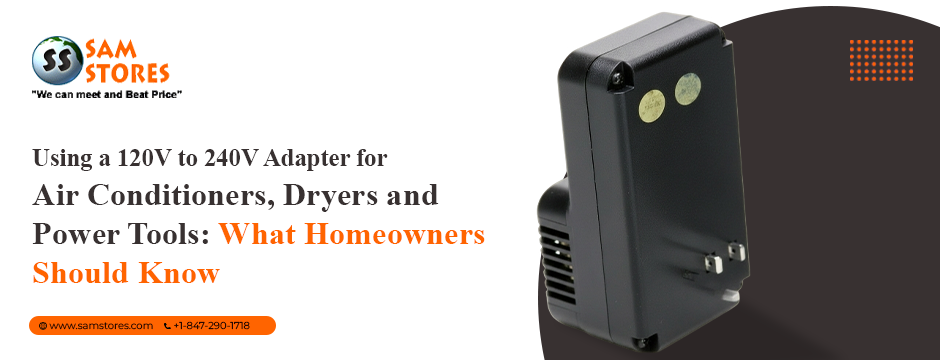
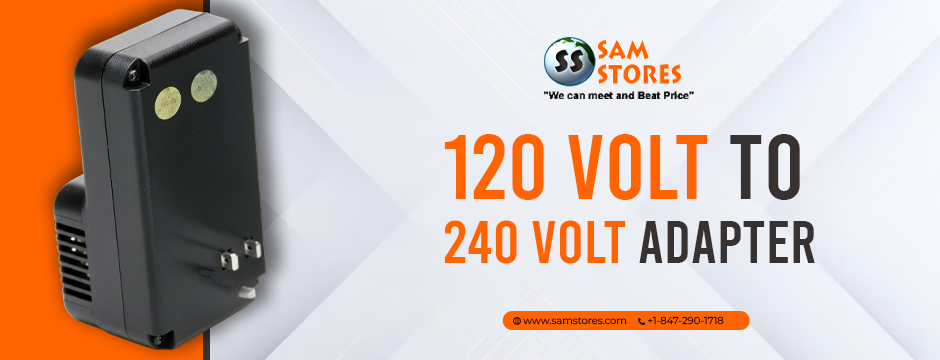
A true 120 volt to 240 volt adapter is not a cosmetic accessory. It is a small transformer that steps up voltage. It takes the 120 volt supply from your wall and boosts it to a level that devices designed for 220 or 240 volts can use safely. This is important because plugging a 240 volt appliance directly into a standard 120 volt line results in poor performance at best and permanent damage at worst.
Some homeowners think they only need a 110 to 220 plug adapter. That kind of accessory simply changes the shape of the plug. It does not increase voltage. If a product requires 240 volts, a simple plug adapter is not enough. This misunderstanding is one of the top reasons people ruin appliances unintentionally.
A proper voltage step up unit ensures the appliance gets the voltage it expects. However, even voltage converters have limits. Every model is sold with a wattage rating. That number tells you the maximum load it can handle. Choose the wrong wattage and you risk overheating the converter or the appliance.
Now that the basics are clear, let us take a closer look at three common household categories that often require 240 volts.
Using a 120V to 240V Adapter for Air Conditioners
Air conditioners are among the most misunderstood devices when it comes to power. Some small AC units run on 120 volts, but many models, especially those with higher BTU ratings, need 240 volts. That is because compressors, fan motors and cooling systems require more power to operate efficiently.
When customers contact Sam Stores about running an AC through a voltage converter, we tell them to start by checking the wattage on the specification label. This number guides the size of converter they need. For example, if an AC draws 1500 watts continuously, the buyer should pick a converter that can handle at least double that wattage. Why double? Because compressors draw additional current when they start up. This surge can easily overwhelm an undersized converter.
Another factor to consider is duration. Air conditioners run for hours at a time. This is different from tools or small appliances that operate for short bursts. Long runtimes create heat buildup. A high quality 120 volt to 240 volt adapter can handle this, but it must have adequate ventilation and a wattage rating with plenty of margin. Skimping here is risky.
For customers who travel or move internationally, a voltage converter is often the only practical way to run their existing AC. For homeowners in the United States who simply bought a 240 volt model by mistake, the better long term solution is usually to install a dedicated 240 volt outlet. Converters can work, but they are not always the most efficient choice for appliances that stay on all summer.
Using a 120V to 240V Adapter for Dryers
Dryers are among the most power hungry appliances in any home. Nearly all full size dryers require 240 volts because the heating element inside them consumes a large amount of electricity. Many homeowners ask if a step up transformer will allow them to use a dryer on a 120 volt wall outlet. Technically, yes, but only if the converter is large enough. In practice, most people quickly discover that the transformer required for a dryer is too big, too heavy and too expensive to make sense.
This is where expectations matter. A dryer can easily draw between 3000 and 6000 watts. To support it, a converter would need to be oversized to handle heat, startup surges and long drying cycles. These heavy duty converters exist, but they are not something the average person wants to keep in a laundry room. They take up space and produce heat, and they are not cheap.
From a safety standpoint, rare is the homeowner who wants a large transformer humming in a corner while a dryer runs for an hour. Because of this, Sam Stores usually recommends that customers install the proper 240 volt dryer outlet rather than attempting to use a converter. However, for compact travel dryers, small European dryers or units sold for RVs and boats, a converter may be perfectly reasonable. The wattage for these smaller models is much lower and manageable.
For people moving from countries that use 220 or 240 volts, a voltage converter might be worthwhile while settling into a new home. Eventually though, many choose to buy a US compatible dryer simply because it is more practical.
Using a 120V to 240V Adapter for Power Tools
Power tools are where converters truly shine. Many workshops contain imported tools such as saws, grinders or rotary equipment that require 220 or 240 volts. These tools often run for shorter sessions and require less wattage than large household appliances. This makes a reliable 120 volt to 240 volt adapter a smart solution.
The key is matching wattage. For example, a European router or planer that uses 1200 watts can be paired with a converter rated for 2000 to 2500 watts. This provides room for surge current when the motor starts. Because most tools operate intermittently, heat buildup is less of a concern compared to air conditioners and dryers.
One point tool owners appreciate is portability. They can take the converter right to the job site, plug in their 240 volt tool and work without installing a permanent outlet. This makes converters a smart choice for woodworkers, mechanics and hobbyists who rely on specialty equipment.
At Sam Stores, we often advise buyers to pick a converter with built in overload protection. If the tool pulls too much current, the converter will safely shut off. This protects both the tool and the converter, and it greatly reduces the risk of overheating.
Heat, Load and Overheating Risks
Any device that steps up voltage generates heat. This is normal. However, using the wrong wattage converter increases heat dramatically. That is where problems occur.
Here are the most common mistakes homeowners make:
- Using a converter that barely meets the wattage requirement
- Running the converter in a confined space without airflow
- Operating high wattage appliances for long periods
- Using a converter meant for travel on heavy household machines
- Relying on plug adapters that do not change voltage at all
If you want to avoid overheating, use a transformer rated for at least twice the wattage of the appliance. This is especially important for appliances with motors or heating elements. Give the transformer open space on all sides to let heat escape. High quality converters often include cooling fans for this exact reason.
Safety Tips When Using a Voltage Converter
Safety is always the main concern. Here are practical steps nearly anyone can follow:
- Choose a converter from a reliable supplier like Sam Stores. Low quality units fail early.
- Pick a wattage rating with a generous margin. Do not push the limits.
- Do not cover the converter. It needs ventilation.
- Use grounded outlets to reduce electrical noise and improve safety.
- Keep the converter off carpets or bedding where heat can accumulate.
- Check cords for wear and replace them if you see fraying.
Voltage conversion is safe when done with care. Problems usually happen only when people buy cheap products or push the wattage beyond what the converter is designed for.
Should You Use a Converter or Install a 240 Volt Outlet
Many homeowners ask which option is better. The answer depends on how long you plan to use the appliance and how much power it draws.
Use a converter if:
- The appliance is small or portable
- You need a temporary solution
- You are using imported tools
- You travel often or work in multiple locations
Install a 240 volt outlet if:
- The appliance is a dryer or full size AC
- You want the most efficient option
- You use the appliance daily
- Overheating or noise is a concern
Both options have their place. Sam Stores carries converters for all appliance categories so you can choose based on your actual needs.
Why Buy from Sam Stores
Unlike random online marketplaces, Sam Stores specializes in voltage converters, transformers and adapters. That means you get honest guidance, not guesswork. Customers often tell us they appreciate simple explanations without pressure. We want you to choose the right product and feel confident using it.
You also get access to a wide range of converters for different wattages, different appliances and different budgets. Every unit is tested for performance and heat stability. That added reassurance matters, especially when dealing with appliances that run for long periods.
Final Thoughts
A 120 volt to 240 volt adapter can be extremely helpful, but it is not a one size fits all solution. Air conditioners, dryers and power tools each have different power demands. Choosing the right converter comes down to wattage, runtime, heat management and your long term plans.When in doubt, the team at Sam Stores is here to help you pick the safest and most practical option for your home or workshop. With the right converter, your imported appliances and tools can run smoothly without complications.